The fog has mostly cleared and I have a sense of what PC expects of me and what I can expect during my 27 months in Ghana. To recap: Following arrival in Ghana we spent 10 days at a conference center getting to know the other volunteers and PC staff, getting more vaccine shots, opening bank accounts, setting up Ghanaian cellphone accounts, getting Ghana ID cards, trying to overcome jetlag and getting accustomed to new foods. For the past three weeks we’ve been immersed in homestay and what PC calls “pre-service training” (PST).
Homestay
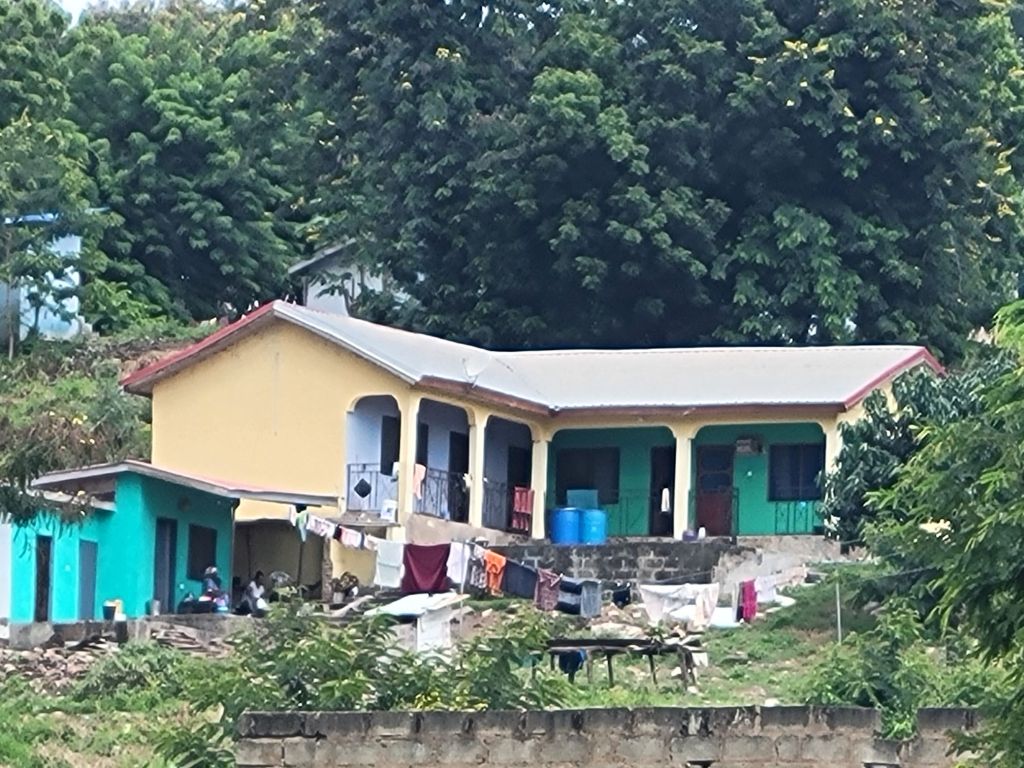


Homestay is an intensive ~12 week immersion into life in Ghana. It involves living with a family in a rural village that’s about 90 minutes away from the capital city Accra (on a good day). I have my own room, which has a ceiling fan (yes!), a bed with mosquito net (malaria is the number one reason for visits to the local health clinic), a small table for eating, and a slightly larger table to serve as a desk, where miscellaneous stuff accumulates. My host family is very nice. Officially my hosts are the mother and father of the household (Agnes and Emmanuel), who are about my age (I let them know how old I am, I haven’t asked their ages.) Unofficially, my primary host is their 35 year old daughter, Eunice, who is exceptionally nice and solicitous. Unfortunately, whereas PC wants us to do almost everything for ourselves (except shopping for food and cooking), Eunice (who went to Polytechnic school for hospitality management) will have none of it. For example, I would have to find someplace to hide my dirty laundry to prevent her from washing it while I’m out. When I try to wash my dishes, she jumps up and says, “No, let me do that!” To be clear, there are no modern appliances in this house – no washing machine, no dishwasher, no stove or oven, no water heater, and no running water for that matter. Laundry is done by hand. There’s not even a washboard – her knuckles are the washboard. My first and only attempt at washing my clothes the way she instructed me to left me with bloodied knuckles. Food is cooked over a wood or charcoal fire. Life here is very much what I call “camping mode”. I can’t say for sure, but I think Eunice’s insistence on doing things for me is a matter of showing respect for elders that is a part of traditional Ghanaian culture. And one of my PC instructors said that allowing men to do domestic chores can be viewed as reflecting poorly on the women in the household. Should I insist on making her uncomfortable just to promote enlightened Western attitudes towards gender roles?
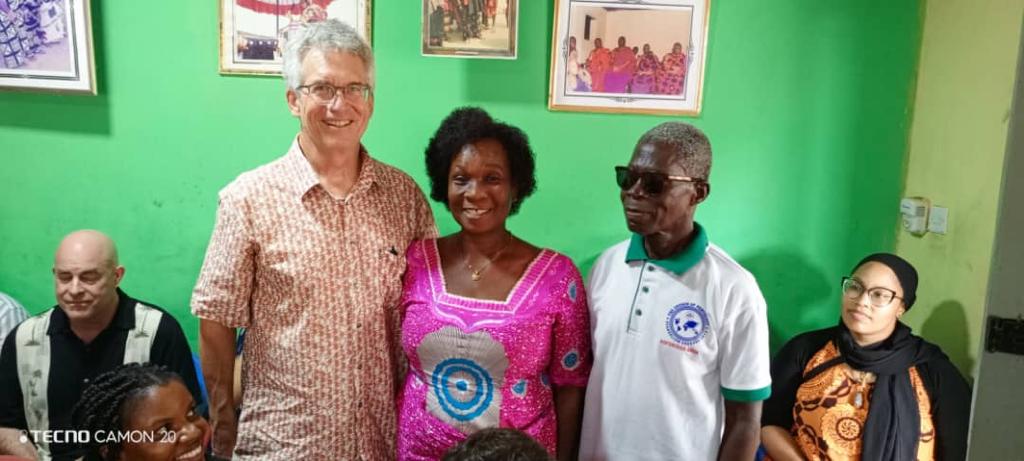
Now, over the years I have spent plenty of time living on my own. I have been a competent cook all of my adult life; I can do laundry and wash dishes and keep a tidy house (more or less); and I have the physical ability to carry a 2 ½ gallon bucket of water on my head when necessary. For that matter, I’ve done my share of camping and backpacking over the years, so I’m no stranger to living close to nature. In short, I’m confident that I have most, if not all, of the domestic skills that PC expects us to practice during homestay. The BIGGEST thing that bothers me about homestay is that I feel guilty having Eunice waiting on me: she has 4 kids, ranging in age from 13 years down to 9 months. Her husband lives and works in Accra. I’ve met him once and he is very nice, but he only gets home a couple of times a month for a brief visit. Agnes and Emmanuel and the oldest boy do some of the domestic work, shopping, and childcare, but my impression is that Eunice does the bulk of the work, while also carrying the baby around on her back most of the day. Meanwhile, there are miscellaneous children and adults who come to visit and stay for a few days at a time. I’m confused about who all the visitors are. The one way that I’ve found to pitch in and help is by finding children’s picture books online for my tablet computer and reading them to the 3 year old boy (who is equally cute and rambunctious). I also hope to find books that I can read to the older boys, who are learning English in school.
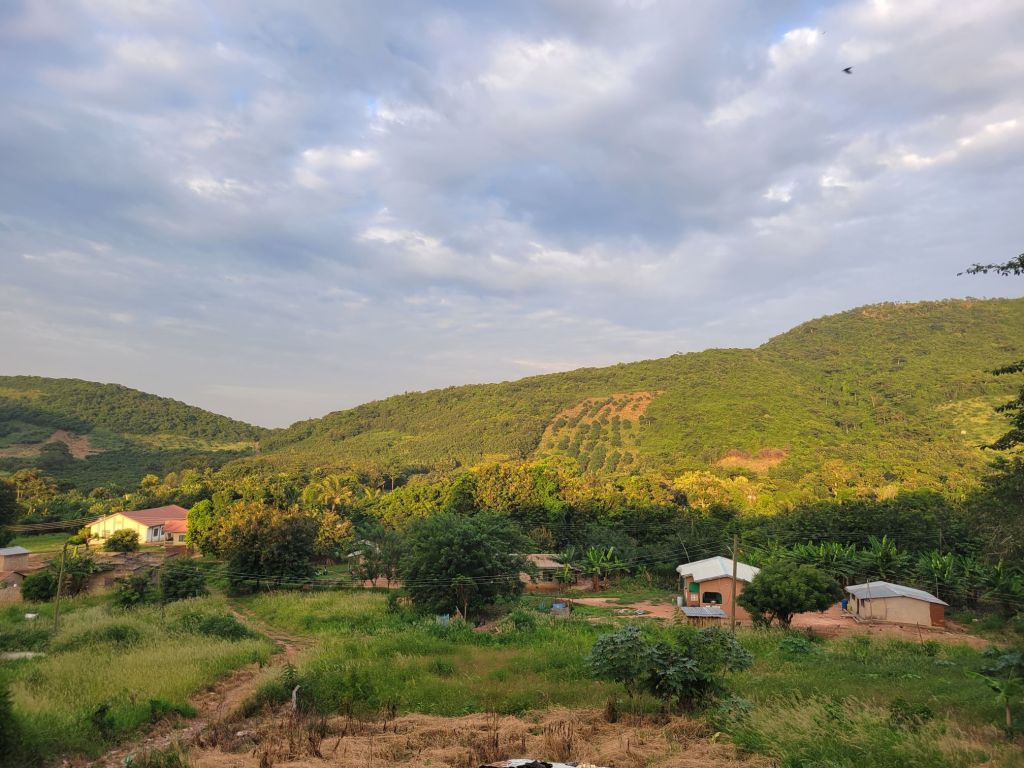
Fortunately, all of the volunteers are in the same village for PST and we’re all within a 10 minute walk of each other. The other volunteers have their own challenges with homestay. For example, all of us are given 2 to 3 times more food than we can possibly eat at every meal. Some are admonished to “Eat all!” Eunice doesn’t pressure me to eat everything, but I suspect that the fact I don’t eat all that she prepares for me is interpreted as an expression of disappointment with her cooking.
Pre-Service Training
PST is the Peace Corps equivalent of boot camp. Strictly speaking, I am not yet a Peace Corps Volunteer – I’m a Peace Corps Trainee. If I successfully complete PST and pass an oral exam demonstrating satisfactory mastery of my assigned language, then I’ll become an official Peace Corps Volunteer (PCV). PST coincides with homestay. During PST we have up to 10 hours of training five or six days a week in language, culture, teaching methods, safety, security, health, and overall survival skills. But mostly we learn language and teaching methods. Our instructors are Ghanaian professionals who are Peace Corps staff members. They also live in the community during our homestay, although they aren’t living with families.
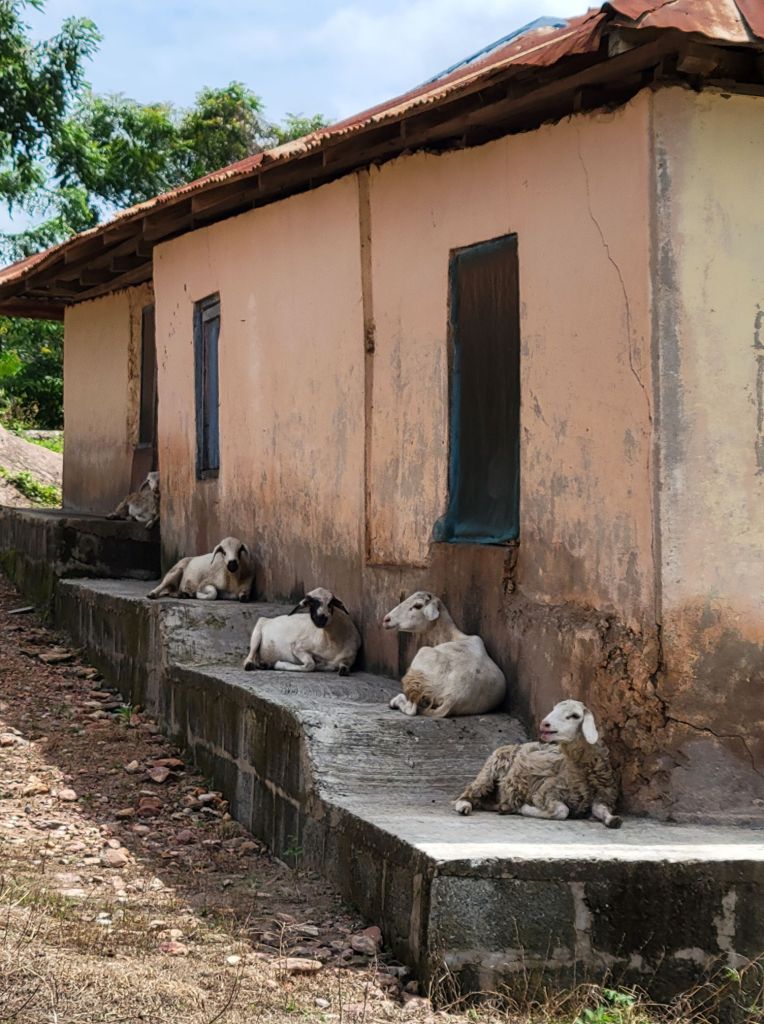
As far as language goes, I’m one of the lucky ones. The language I’m learning is Twi (pronounced chwee). Most of the residents of this village speak at least some Twi, and we are strongly encouraged to practice speaking Twi with virtually everyone we pass on the road as we walk between home and the churches in the community that serve as our meeting places for various classes. Other volunteers are learning languages that aren’t commonly spoken here, so they have fewer opportunities outside of class to practice speaking their assigned languages. Learning to speak a language is important because it will help us integrate into the communities to which we’ll be assigned. And that’s important because once we complete PST (assuming we pass our oral language examination), then we’ll be dispersed around the country. I won’t be able to walk 10 minutes to meet up with a PC friend/colleague; I’ll be all by myself in a new village. I’ll be the only Peace Corps Volunteer in my village and probably the only Western person in my village. I’m guessing that I’ll have to travel at least an hour to meet up with a fellow PC volunteer. So being able to speak the language and get to know people (and introducing myself to them) will be an important part of a successful Peace Corps experience.
The workload during PST ramps up continuously. I feel like I’m drinking from a firehose. I could spend all day studying and practicing language, but I also have to focus on the fundamentals of teaching. Next week I’ll be a student teacher, during which I’ll teach four one-hour Science classes to 7th grade students and four one-hour Science classes to 8th grade students. The following week I’ll do the same, teaching Math instead. I’ve already experienced the crash and burn of attempting to teach a 15 minute lesson to 7th graders. My hat is off to all the teachers reading this.
In two weeks or so, after I’ve completed my student teaching, I’ll find out where I’ll be located for my two years of service and meet my Counterpart, a person from that village who will be a key resource person when I get there. Together we’ll travel there and I’ll spend a week becoming familiar with the school, the village, and the people.
Stay tuned for further adventures!
Comfort Zone – Update
Well, I’ve concluded that my comfort zone has been irretrievably lost, probably somewhere over the Atlantic. That’s OK, I’m starting to build a new one. It’s fairly small right now, but eventually it will be much bigger than the old one. I mean, it will contain all the stuff that the old one had – cooking, driving, international travel – but I’m going to expand it. Not fancier, mind you, just bigger. For example, so far I’ve carved out space for a variety of new foods, along with pit toilets, chamber pots, feeling sweaty and/or sticky most of every day, bucket baths, and mosquito nets. It will have space for sporadic and intermittent internet outages along with routine electrical power outages. There will be a robust corner for building warm relationships with complete strangers who welcome me into their home, prepare all my meals for me, and generally look out for my happiness and well-being in spite of the fact that we speak very little of each other’s languages. And I’m learning a new language in preparation for when I’ll be alone in a strange city trying learn what’s a fair price for the taxi or tro-tro that will carry me along on the next leg of a journey. Somewhere I’ll also find space for standing in front of a classroom full of kids who struggle to understand my thick American accent while I’m trying to teach them math and science. Now I’m not naïve. I’ve done enough home improvement projects in my life to know that it will take more than a few weekends to get this job done. I’ll keep chipping away at it.

Bonus content: Cross cultural communication
My first job out of college was at the Research Triangle Institute in North Carolina. I worked on research projects funded by the US Environmental Protection Agency studying ways to improve equipment used to reduce air pollution from coal-burning power plants. A month after I started, the person who was to become my officemate arrived. Dr. Ashok Damle was born, raised, and obtained his undergraduate degree in Chemical Engineering in India before attending graduate school in the US. Ashok is amazingly smart and every bit a gentleman. Developing complex mathematical models using advanced calculus comes as naturally to him as breathing. Ashok also wears hearing aids. I never delved into the topic with him, but my perception is that he was born with a hearing disability, which consequently affected his speech. With a little practice, one could understand him pretty easily.
Ashok and I became friends over the next six months or so. One day there appeared a colleague who we hadn’t met before. Carlos, who I believe was born in Honduras, was raised in one of the boroughs of New York City (sorry, I don’t know which one). Consequently, he had what sounded to me like a New York City accent – not overly strong, but what I would describe as characteristic of New York. We hadn’t met Carlos before because he had been working on a field project for those first six months that Ashok and I had been getting acquainted. Within a day or two of Carlos’s appearance, the three of us went to lunch together. To my surprise and amusement, it quickly became clear that, although they were both speaking English, Ashok and Carlos simply could not understand each other. I had no trouble understanding them both, but no amount of repetition or rephrasing by one or the other could break through the communication barrier. I served as a translator for that first lunch and ever so slowly over the course of weeks Ashok and Carlos began to understand what the other was saying.
I was reminded of that story because Peace Corps has been teaching us lately about cross cultural literacy. What’s that? At heart, it’s about recognizing and acknowledging that two people who are intelligent and fully capable in their natural environments can appear to be unintelligent and incompetent if those environments are swapped. I know that I appear to be a babe in the woods with most Ghanaians that I encounter on a daily basis. That’s OK, I’m a grown-up, I’m learning the local language, I’m finding my way around, and I’ll do my best to become culturally literate. The greater concern arises from the fact that I’ll be an authority figure to my students, teaching them in English. They’ll be doing their best to try and understand me, but there’s the communication gap. Whose English should we speak? That is, I’ll be speaking American English. They’re accustomed to hearing Ghanaian English. There’s a big difference in pronunciation, speed of speaking, vocabulary, and phrasing. Such differences made it impossible for Ashok and Carlos to communicate with each other. Sure, I’m the teacher so they should have to make the effort to understand me, right? But I’m working in their country, and my students will just be kids. I have to make the effort to speak to them in a way that they understand.
In addition to that, we have to consider the differences between the perceptions and understanding of the world from the perspective of a college-educated American and a junior high student from Ghana. A lesson on glaciers, for example, might be easy for a kid from Montana or Colorado or Alaska to grasp, but for kids from Ghana you would have to start by talking about how snow falls on mountains and gets compressed into ice and once you get enough ice, it starts to slide down the mountain. Snow, ice, and glaciers are not everyday phenomena for kids in Ghana. They’re not dumb; they’ve just never seen anything like it and would have difficulty grasping the concept. It’s mind-blowing as we used to say. I have to be alert to the potential for that sort of confusion and make the effort to help them bridge that knowledge gap.
All of which takes me back to a controversy in American education from a few decades ago that I now see in a different light. Teachers started acknowledging the existence of a gap between the standard English spoken in schools and the language spoken by children in some African American communities. Peace Corps introduced me to the term “playground language”, meaning the language that children use to communicate with each other when they’re out playing on the playground. Education specialists in the US referred to that playground language in African American communities as Ebonics and advocated for the recognition and use of Ebonics as a bridge to help children learn to read and write in standard English. The kids were just speaking the language they learned in the home (and on the playground) since the day they were born. If we want to educate them rather than penalize them, we should speak to them in the language they understand while also giving them the tools to be able to read and write the language they will need to be successful in life.
Sadly, but predictably, the use of Ebonics came under attack from politicians and culture warriors (i.e., the usual cretins). Its use was attacked, ridiculed, and vilified. I don’t know the status of it today and whether or not children are benefiting from it. I just hope that children aren’t struggling to learn to read and write because teachers don’t know how to or are prevented by law from reaching out to the kids where they are, rather than where some think they ought to be.


 Not A Typical Day
Leave a reply to Todd Cancel reply