August 18, 2023
Hello, just checking in after another hectic month. The time flies by; I can’t believe it’s been over a month since I last gave an update. Let me start with some simple geography facts:
Ghana is located about 400 miles north of the Equator. That’s a latitude of about 6 ½ ºN; for comparison, Honolulu is 21.3 ºN. Being so close to the Equator (relatively speaking) means that we consistently have about 12 hours of daylight and 12 hours of dark every day, year-round. There’s no Daylight Savings Time here because it just wouldn’t make any difference. At the same time, you’ll be forgiven for thinking that it must be pretty hot here on account of being so close to the Equator. I haven’t had the opportunity to check the local weather records, but I don’t think the temperature has been over 90 ºF yet this summer in the places I’ve been; it certainly hasn’t topped 100. In other words, by coming to Africa I’ve escaped the blistering heat that so many in the US have been coping with. Go figure. And like the daylight hours, I don’t think the daily temperature will change a lot over the course of the year.
Another difference that will take some getting used to is that Ghana has only two seasons: the dry season and the rainy season. The duration and timing of each vary depending on where you are in the country, but in general, the dry season is between October and March and the remainder is the rainy season. From what I’ve experienced so far, it doesn’t rain every day in the rainy season. When it does rain, though, it can be a real downpour.
I provide that geography lesson to set the stage for the next topic.
A Typical School
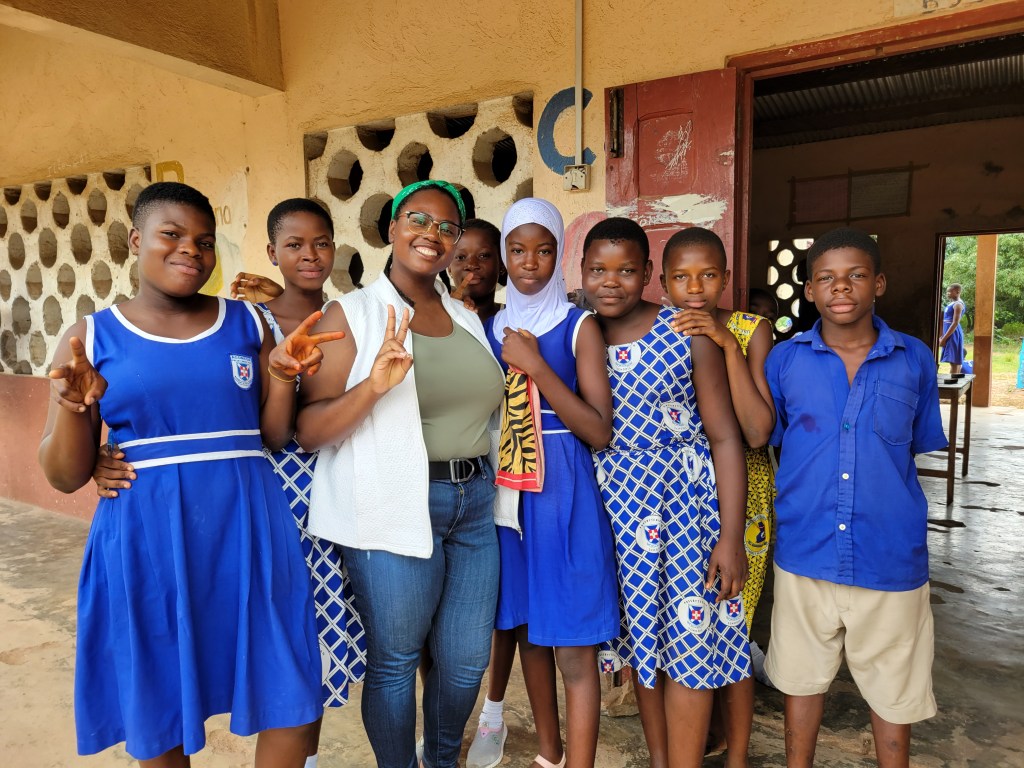
Before I talk about student teaching, let me describe the school. It includes grades from Kindergarten through 9th grade. The photo above shows my PC colleague Gaelle with some of the 7th grade students. (We taught 7th and 8th grade students for our student-teaching exercise.) They’re standing on the porch in front of a typical classroom. The classroom is an open-air structure (i.e., no windows to close – the temperature indoors is generally the same as that outdoors). On the right is a doorway into the classroom. You can see through to the door on the other side of the classroom. The boy in the picture could take two steps to his left and touch the chalk board, which stretches the width of the classroom.
There are two ceiling fans in the classroom that aren’t used and two empty sockets for lightbulbs. Apparently, the price of electricity in Ghana went up 18% on June 1, so that might explain why electricity isn’t being used, although the spartan approach may pre-date that. In short, electricity is considered to be a non-essential expense.
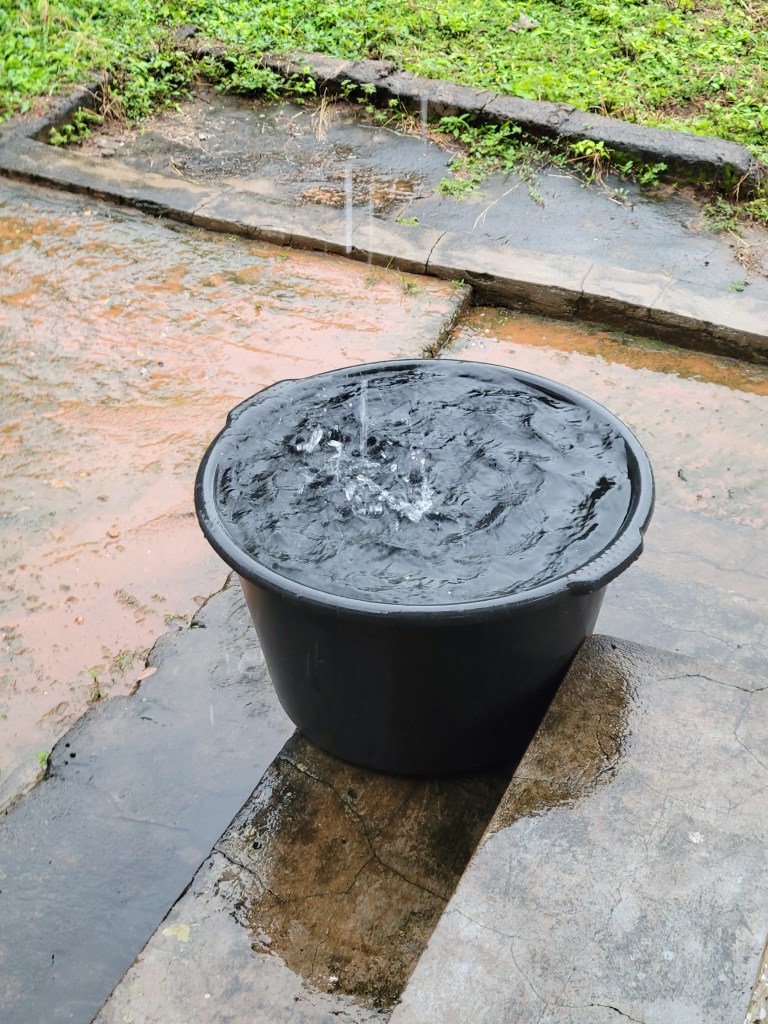
The ceiling fans aren’t actually on the ceiling because there isn’t a ceiling; when you look up you see the underside of the corrugated metal roof. So call them “rafter fans”. The lack of a ceiling is a problem when one of those rainy season downpours occurs. To get an idea of what that sounds like, stick your head in a drum when someone’s playing on it hard and fast. Then, of course, there are the leaks in the roof that drip down into the classroom, which necessitates rearranging desks to avoid getting wet. The students have learned where the leaks are, so it’s an automatic drill to shuffle desks when it starts to rain. I had to cope with a loud, heavy downpour during one of the classes I taught for student teaching. Afterwards the teacher who was observing me said he wondered what I would do when the rain started (I kept slogging on). He said that he’ll usually give the students an assignment to work on quietly at their desks while waiting for the drumming to abate.
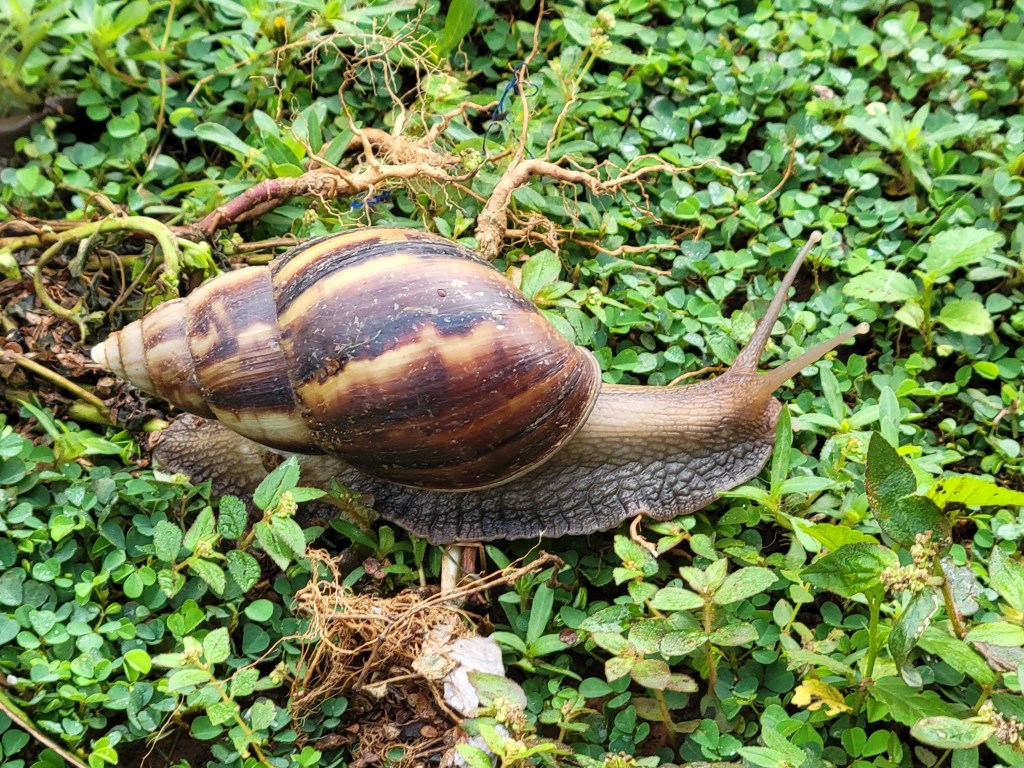
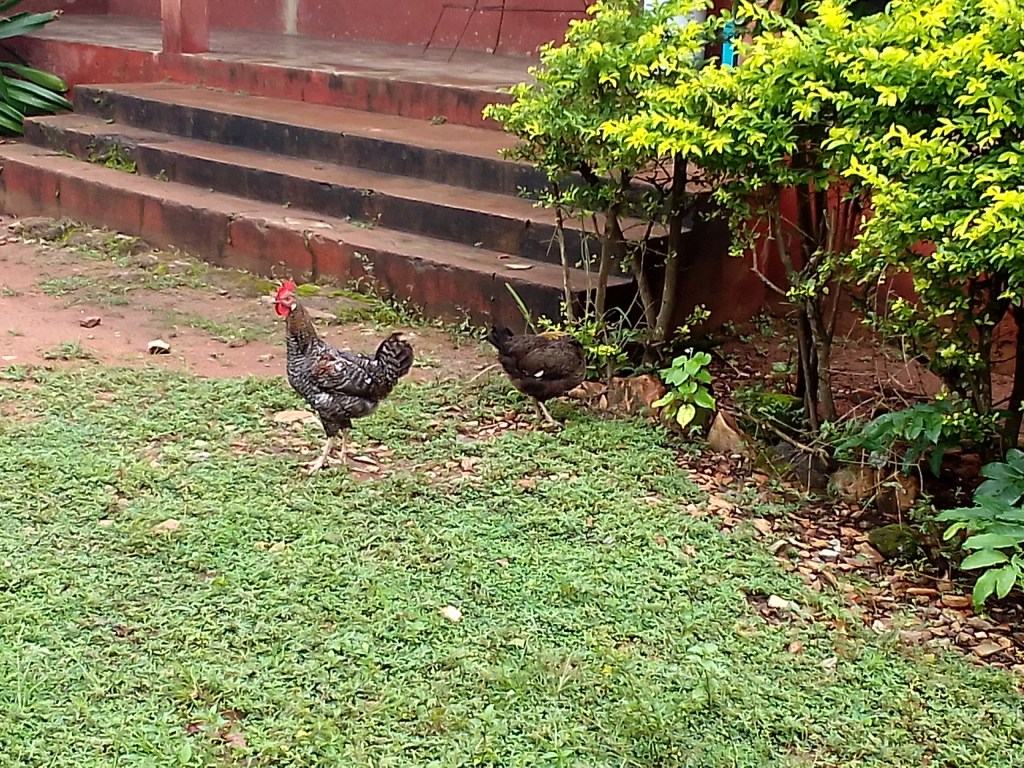
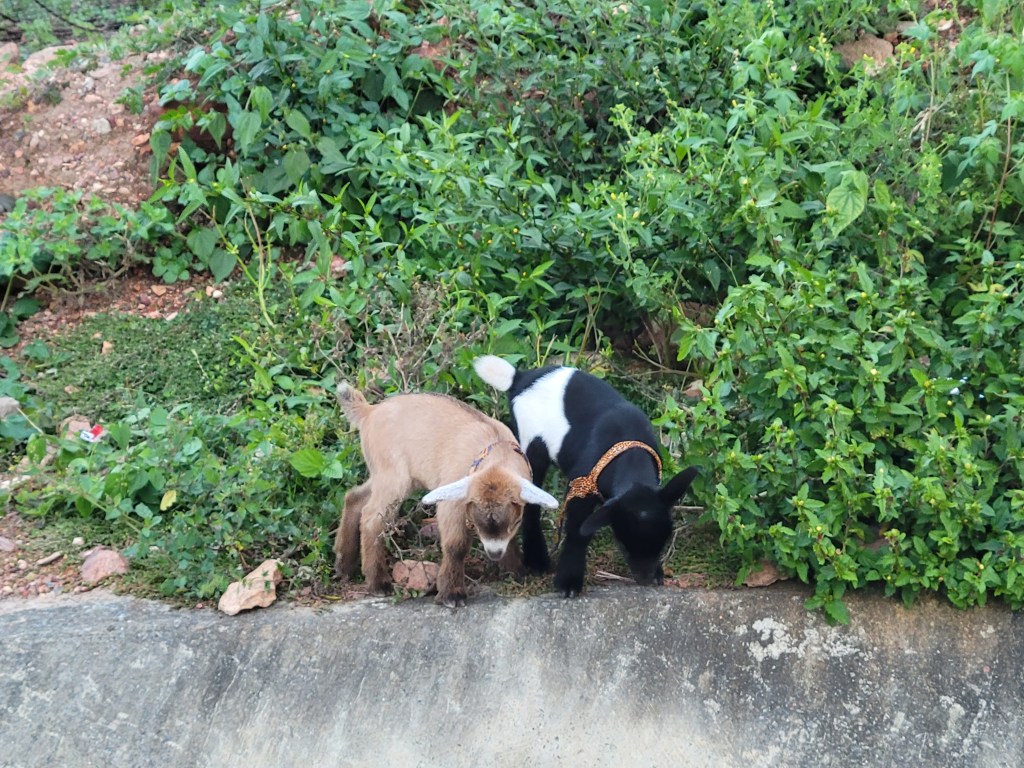
Other random observations about the school: there are four separate buildings loosely arranged in a square, although the buildings don’t touch each other. Chickens, goats, and other miscellaneous animals meander through the grounds throughout the day. Students are expected to arrive 30-60 minutes before school every day to tidy up the place (mostly sweeping of the porches and compound). School starts with an assembly. In this case, “assembly” means that students line up in the courtyard by class (girls in front, boys in back). They say a prayer, recite the Ghanaian Pledge of Allegiance, and sing the national anthem. Then a couple of the older students start beating a marching cadence on some drums and the students march by class into their rooms.
Lest you conjure the image of an orderly and disciplined institution, the teachers only start drifting into the compound at about the same time that the assembly begins. They may not get there before the students arrive in the classroom. It’s not uncommon for some teachers to bring their infants or toddlers to school with them. When a baby needs to be nursed then the students are left to their own devices while the teacher finds a relatively quiet spot to tend to the baby. The toddlers wander around the courtyard area and in and out of classrooms (all the doors are left open throughout the day). Don’t worry – the courtyard also serves as the teacher lounge / office area (i.e., a few wood tables with chairs and benches arranged under a shade tree), so there’s always someone around to keep an eye on the toddlers. Now, please, I don’t mean to be negative about the teachers – they’re underpaid and resources (such as daycare) that are supposed to be available aren’t. So they try hard given what they have to put up with. It’s just a reflection of the big gap between good intentions and reality.
And now a word to you, our sponsors
Not all schools operate without electricity. My friend and fellow volunteer Liz is working to bring a computer lab to her school. Believe it or not, in Ghana it’s not uncommon for teachers to explain to students how to use a computer program (e.g., Microsoft Word) by writing on a chalkboard because there are no computers available for hands-on instruction. (And you thought that instruction via PowerPoint was tedious!) Liz’s project is a typical example of a volunteer working together with their school / community to make an improvement to the community that will be sustainable long after the volunteer leaves. I’ll be developing some sort of project next year. Funding for projects comes from two sources. First, the community itself makes a significant contribution. This is usually done with “in kind” contributions (e.g., provide materials and labor to build a new room onto the school to house a library or computer lab). Second, the volunteer seeks funds from family and friends to cover the remainder of the cost. If you would like to learn more about Liz’s project to build a computer lab at her school and possibly make a donation, then check out this link:
https://www.peacecorps.gov/donate/projects/pp-23-641-001/
Thanks!
Student Teaching
My preparation for becoming a classroom teacher consisted of less than 40 hours of instruction over the span of a month. I’d heard of terms like “classroom management” and “lesson plans” before, but I really had no idea what they meant. I was disturbed when the discussion of classroom management started with the topic of “whiteboard management” (what?!? Do whiteboards misbehave?). I have come to appreciate the value of lesson plans (i.e., planning ahead), although I’m still not good at putting one together.
So, with that crash course in teaching under my belt, I marched into 7th and 8th grade science classes (4 hours of each) for Week 1 of my practice teaching. I broke the ice by acknowledging that the way I talk must sound very funny to them, but I am, in fact, speaking English. They laughed and agreed that my speech sounded very funny. I promised to speak slowly and clearly (and for the most part I succeeded in that). Having made that important connection with the students, I proceeded to bore them to tears. Part of the problem was the subject matter, part of it was my lack of imagination. In my defense, I really don’t think the idea of “student-centered learning” (vs “teacher-centered learning”) had been discovered yet when I was a child. My siblings can correct me, but I don’t recall activities such as group-work or games intended to enliven a concept and stimulate interest. We paid attention in class while the teacher lectured, we did exercises alone at our desks, and we did homework. I’m not arguing with the evolution of teaching methods – I just had no experience with them.
The challenge was exacerbated by the lack of clear direction on exactly what I was supposed to be teaching. I had a copy of the national curriculum, broken down by “strands” and “sub-strands”, but the description of what the students should learn was pretty spartan. I had to teach the 8th grade about ecosystems. I think the word “ecosystem” had only just been invented when I was in 8th grade. I had to learn about producers and primary consumers and secondary consumers, and miscellaneous other concepts, then figure out a way to teach it to the students. For the 7th grade I had to teach about ways of generating electricity and the impacts on the environment. I had my first success when I brought the solar panel I had purchased with an REI gift card (thanks 3Mers!) and a miniature fan to school with me. The kids were wowed by the demonstration of powering a fan directly with the energy of the sun. Turn the panel upside down (so no sun strikes it) and the fan stops. Turn the panel to face the sun again and the fan spins back to life. I made a point of showing that to the 8th graders, who enjoyed it just as much.
Gradually my comfort with the students improved, as did my teaching method. Perhaps the biggest challenge was getting a grasp of how much the students understood. Did their mute response to my questions reflect a communication gap or did they just not know the answer? Moreover, I started to get a sense of what was meant when the curriculum guide talked about teaching critical thinking skills. It makes sense, but wow. We have to teach the kids how to think (not unique to Ghana by any means).
Gradually over the two weeks of student teaching I got to know the kids a little bit. Perhaps it’s universal, but the students generally weren’t enthusiastic about raising their hands to ask or answer questions. And when they did volunteer, they spoke in such a soft voice that it was usually hard to hear what they were saying (never mind the question of which version of English was being spoken). I did finally get a rise out of them on my last day of teaching when I told them it had been more than 50 years since I was in Junior High School. One boy raised his hand sky high, stood up tall, and asked in a loud, clear voice, “How old are you ??!!” It made me think I can connect with my students and establish a rapport.
Business name of the month: Just Believe Laundry – I like the philosophy although, to be honest, my motto is “Good Enough Laundry”.
Comfort foods: If we’re lucky, my cohort convenes about once a week for a beer or two. It tastes soooo good.
A big thanks to my PC colleague Nathan who had to go to Accra (the capitol city) for some dental work. He brought me back a kilo of roasted coffee beans. It helps me start the day right.
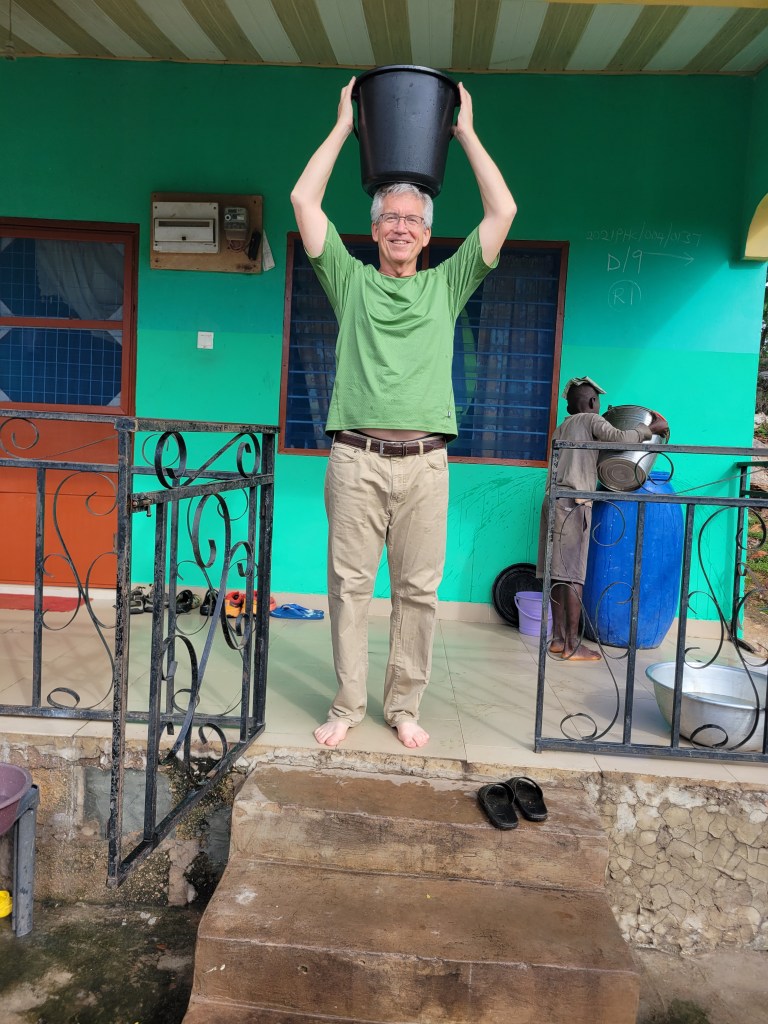
Preview of the next episode: We (soon-to-be Volunteers) spent a week at the end of July visiting the sites where we will be located for the next two years. It was enough time for us to get a sense of who the people are, where we’ll be located, and what our living conditions will be. My key Contact Person helped orient me and then we talked about what I’ll do when I return at the end of August. I tried hard to avoid making any great promises about what I will accomplish in my two years, so I was a bit concerned when I realized that he talked about my return at the end of August as my “second coming”(!). I trust there’s no crucifixion involved.


 Not A Typical Day
Leave a reply to lglynch Cancel reply