September 11, 2023
The title above is among my favorite movie lines and it feels quite appropriate right now. After 11 challenging weeks of training, followed by a day of ceremony and celebration on August 24, my cohort and I are now official Peace Corps Volunteers (PCVs). The day after our swearing in ceremony we were all on our way to our assigned work sites. If Pre-Service Training was equivalent to boot camp, then arrival at our work sites has felt like parachuting into uncharted territory (at least for me it has). I’ll try to explain.
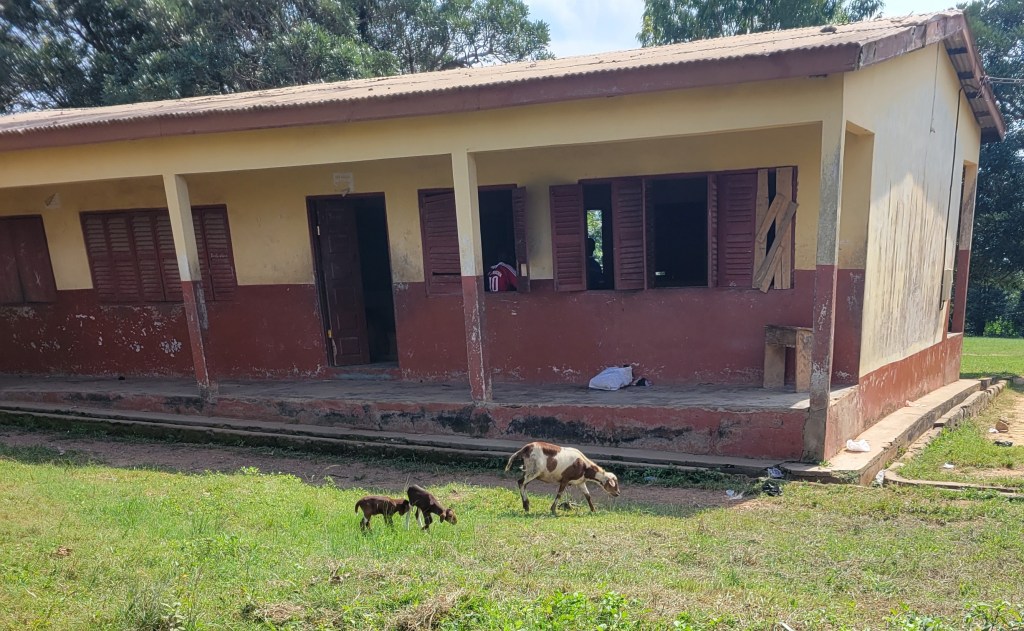
Site Integration
The first three months of a Volunteer’s life in their community after swearing in are referred to as “site integration”. The ideal of site integration is that you meld into the local population and culture; you blend in and become one with your surroundings. You meet and talk with the people, you participate in local activities (go to church, go to market, cook and eat the local food) and generally become an accepted member of the community. Peace Corps explicitly abhors the “savior” model of development – the idea that the Americans are going to ride into town on their white horses, organize, fund, and complete some development projects, and then ride off into the sunset. Instead, as part of integrating into our communities we learn about the people, the problems, and the concerns that they have. We listen and observe to find out what the community wants and needs (e.g., a new well for water, a public latrine, a library in the school, a computer lab), what they are willing to invest their own time and materials to help bring about, and whether they have the interest and ability to sustain a project long after a Peace Corps Volunteer has departed. So, the role of the Volunteer is not to charge in, identify what needs to be done, and then be a Project Leader. Instead, the role of the PCV is to teach and facilitate, providing guidance so as to help the community to help themselves (as well as help identify sources of funding). And although, as a teacher, my primary role is to teach math and science, we’re also expected to work with our community on an improvement project. But for the time being I’m just trying to integrate and get my feet on the ground as a teacher.
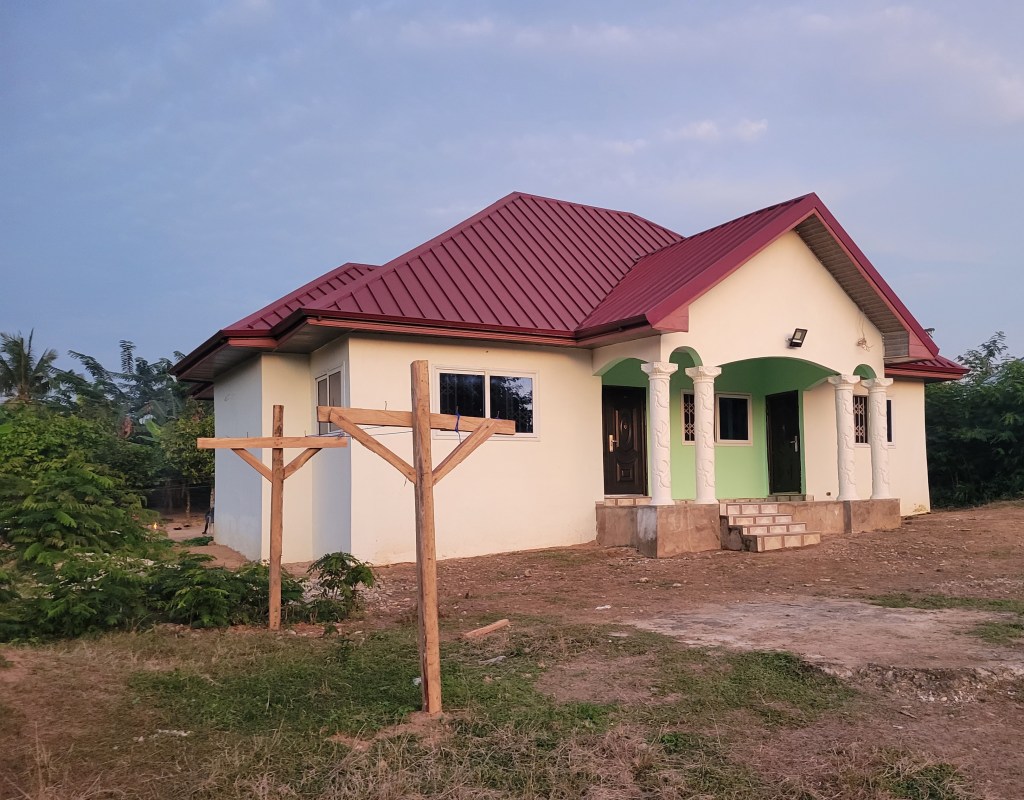
Social Obligations
So how, exactly, does one go about integrating? Well, the most important thing is to get out and meet people in the community. Ghana makes that easy to do, in a couple of ways. For starters, the most common mode of transportation is by foot. Whether going to school, church, shopping, or wherever, people are out walking. In addition, houses are close together and there are at least four people living in each house, often more. A common form of housing is a “compound” in which many rooms surround a courtyard, with multiple occupants in each room. So, no matter where you are in the town, there are a lot of people that you could encounter.
Another aspect of life here is that people spend a lot of time outside of their houses. Cooking is commonly done outdoors over a charcoal fire. Eating and socializing generally take place outdoors as well. Many occupations are also done in small shops at home (e.g., casket building). When you combine population density with the amount of time people spend outdoors, it means that I can hardly walk 10 feet without encountering someone walking or lounging or working outside their homes.
The second way that Ghanaian culture makes it easy to meet people is that there is a long-standing tradition of greeting (almost) everyone you meet. There’s a pretty standard script that even a rank beginner can follow. Mind you, the greeting is done in the local language (in my case Twi, pronounced chwee). The standard greeting goes something like this:
A: Good morning / afternoon / evening!
B: Yes, brother / sister / father / mother / child / friend / …
A: How are you?
B: I am fine, how are you?
A: I am fine as well.
There’s actually a fair degree of latitude permitted in this exchange. For example, it’s probably more common to hear, “By the grace of God I am fine, how are you?”. Even if you don’t understand what a person said, you can just say the next line in the script and people will know your intention, even if the words don’t line up exactly. The thing that never changes in this exchange is the wellbeing of the two participants. Even if you just lost your job, your house burned down, and your dog died, you must say, “I am fine.”
Once this mandatory greeting is out of the way, you can either extend the conversation or excuse yourself and be on your way. That is, until you meet the next person along the way and go through the exchange all over again. Depending on how much I’m out and about on a given day, I can go through this greeting ritual a couple of dozen times in a day. Peace Corps taught us that we have to include enough time in our travel plans to permit us to greet people properly because people take this ritual very seriously. If you walk by a person without greeting them then they might be very offended. Using the greeting with shopkeepers will generally get you better service. If you want to ask someone on the street for directions, then you’d better go through the ritual greeting first.
For those of us accustomed to being focused on our destination, proceeding there with all deliberate speed, completing our business, and then heading directly home in the same fashion, the Ghanaian way of doing things requires a bit of adjustment. And it’s compounded by the fact that the greeting is often just the start of an exchange. People will ask who you are, where you are from, why are you here, where you are going, and anything else that interests them about you. Of course, that exchange also takes place in Twi. To be honest, I can recite standard phrases that I’ve memorized (I’m from America; I’m here with US Peace Corps; I will live here for 2 years; I teach math and science; I speak little Twi), but I don’t have the language skill required to have a real conversation. To do that I would have to be able to understand what a person is saying to me (beyond the basic questions), then I would have to think of an adequate response in realtime using my limited vocabulary. Since arriving here almost two weeks ago I’ve spent a couple of hours each day studying language, but I’m still woefully unprepared to communicate effectively. That said, people are surprised and pleased to hear me speak Twi, if a bit mangled and spoken with a funny accent (kind of like Chewbacca). It makes them laugh and smile, which is generally good; however, the novelty of the one-trick pony wears off pretty quickly, so I have to continue learning and practicing every day.

While I try to greet everyone I meet (it’s too crowded in the center of town to greet everyone), I make a special effort to greet the elderly, for two reasons. One, they spend a lot of time sitting in front of their homes, watching the world go by and I think they appreciate getting the attention. They also have the patience to talk to this stranger who looks and talks funny. And two, there’s a general respect for elders here, so I’m making a conscious (calculated?) effort to ingratiate myself with them. I’m hoping that if I greet grandma and/or grandpa (“Oh yes, I remember meeting the obroni. He was cheerful and courteous, even if I couldn’t understand a word he said.”) then it could smooth the road to acceptance.
I also wave and say hello to young children as much as possible. It’s not uncommon for a gaggle of four, five, or six kids, from toddlers to 1st or 2nd graders, to come running and waving, smiling and shouting excitedly “Teacher Kwadwo! Teacher Kwadwo!” (my name at school, pronounced Kwa-jo). Sometimes I hear my name called but don’t see the child, so I’ll back up until I can spot them and make eye contact, then wave back to them. My theory is that their greeting of me shows: a) they know who I am, b) they’re not afraid of me, and c) even better, they’re excited to see me. My hope is that I will at least appear to be harmless to their parents. As a bonus, maybe it sparks sufficient interest that the parents learn more about “Teacher Kwadwo” from their kids, neighbors, or other parents and they form a favorable opinion, thus smoothing integration. At least that’s what I tell myself.
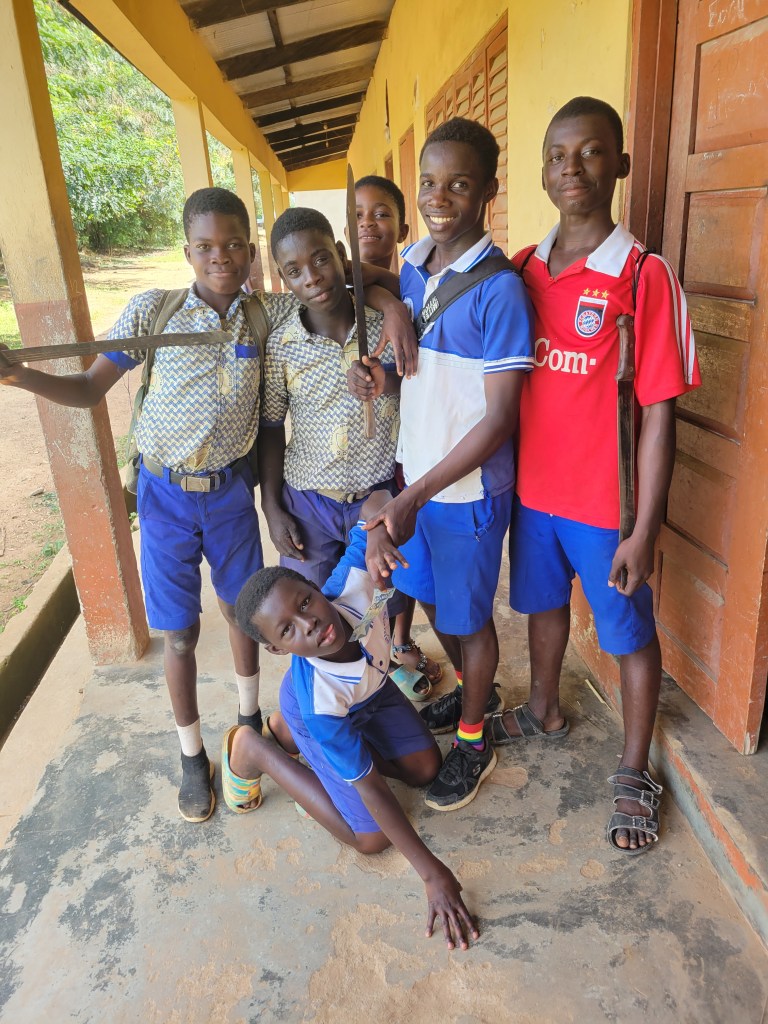
Obstacles
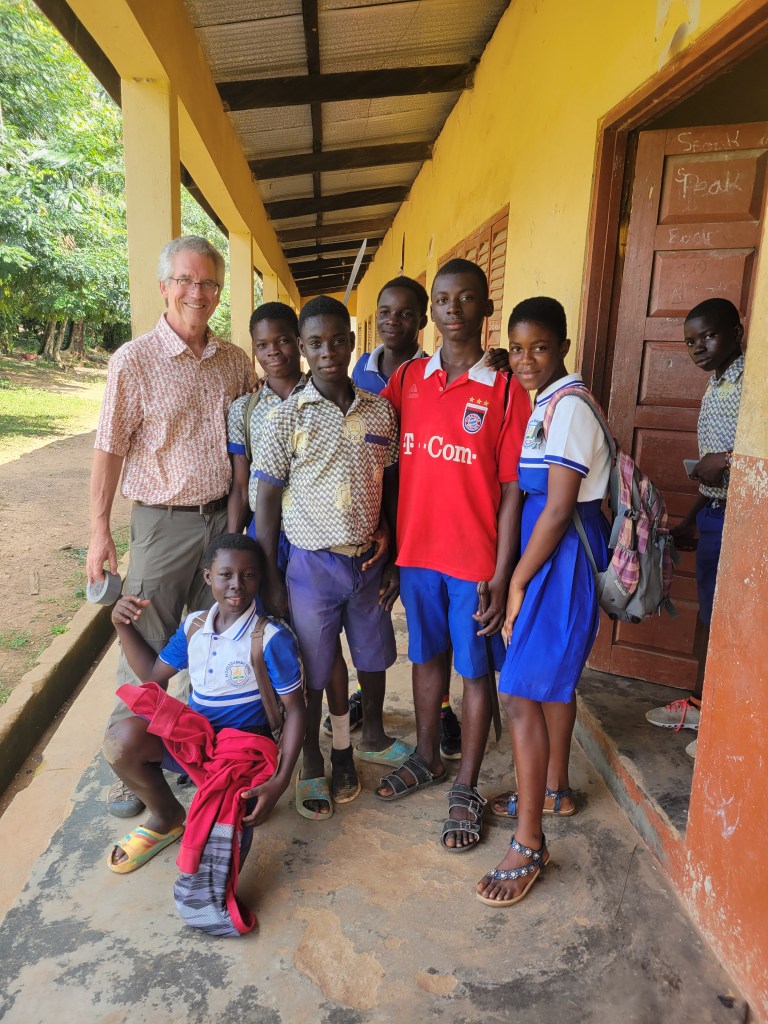
There’s no way around it: My skin color is a hindrance to integration, coupled with the fact that I am from “America”. That’s kind of a double whammy because, 1) I’m unmistakable and 2) being from “America” kind of gives you the equivalent of rock star status. As far as being unmistakable: to the best of my knowledge, I’m the only Caucasian person in this town of 8,000 – 10,000 people. There was another white person here when I visited briefly last month (a Mormon missionary), but he left. I never met him; I saw the back of his blond head and the white skin of his arms in a short-sleeve shirt once, from a distance. So I’m kind of conspicuous. Imagine meeting someone for the first time and hear them say, “Oh yes, I saw you at the market on Friday.” I can’t honestly reply, “I remember seeing you, too.”
As far as “rock star status”, I suppose it’s more like I’m from the Promised Land, or at least everyone’s favorite dream destination. Many people tell me outright that they want to go to America; some will ask me (only half jokingly) to take them with me when I go home. A few will ask if I can help them get a visa to get into the US. Being asked to share the burden of others’ hopes and dreams can feel a bit overwhelming.
Another aspect of being from “America” is that you are, by virtue of your origin, rich – at least by Ghanaian standards. This is a challenge for Peace Corps generally around the world. Even recent college graduates, who may have significant student loan debt, are assumed to be rich (‘hey, you’re from the Promised Land’). To be honest, no one has asked me explicitly if I’m rich, but movies and TV from the US portray life as opulent and glamorous. A “middle class” family on American TV looks pretty wealthy to a Ghanaian. That perception has to be overcome in order to integrate into my community. For the record, while I am serving as a Peace Corps Volunteer I get a wage that is comparable to what a local teacher earns. When I told that to my teacher counterpart, his reaction was, “Oh, you can’t afford to live on that!” (Time will tell; he works odd jobs on nights and weekends to make ends meet – and he’s single). In that regard, Peace Corps arranges and pays for my housing, but all expenses beyond that (food, transportation, clothing, teaching materials, entertainment, …) are supposed to be paid for with my PC income. Extraordinary expenses (e.g., a vacation to the US) would have to be purchased with savings from home.
ET
Which brings me back to one of my favorite aliens. I, too, feel as if I’ve landed on a foreign planet. So much is new to me – language, food, culture. Everyone here assumes that I’m familiar with their traditions (i.e., “normal behavior”). I had 11 weeks of training side by side with my cohort colleagues, but now I’m on my own. I can’t hide in a closet eating Reese’s Pieces, waiting for the mother ship to come take me home. Instead, I have to go out everyday to meet people, let them see me, let them touch me (kids are especially curious about my white skin and my straight hair), and try to speak with them. And gradually the novelty will wear off and I won’t stand out as much as I do now. Because the only way this alien could be more conspicuous right now would be if I had two heads.


 Not A Typical Day
Leave a reply to ghanaandy Cancel reply