March 11, 2024
Finding the right balance
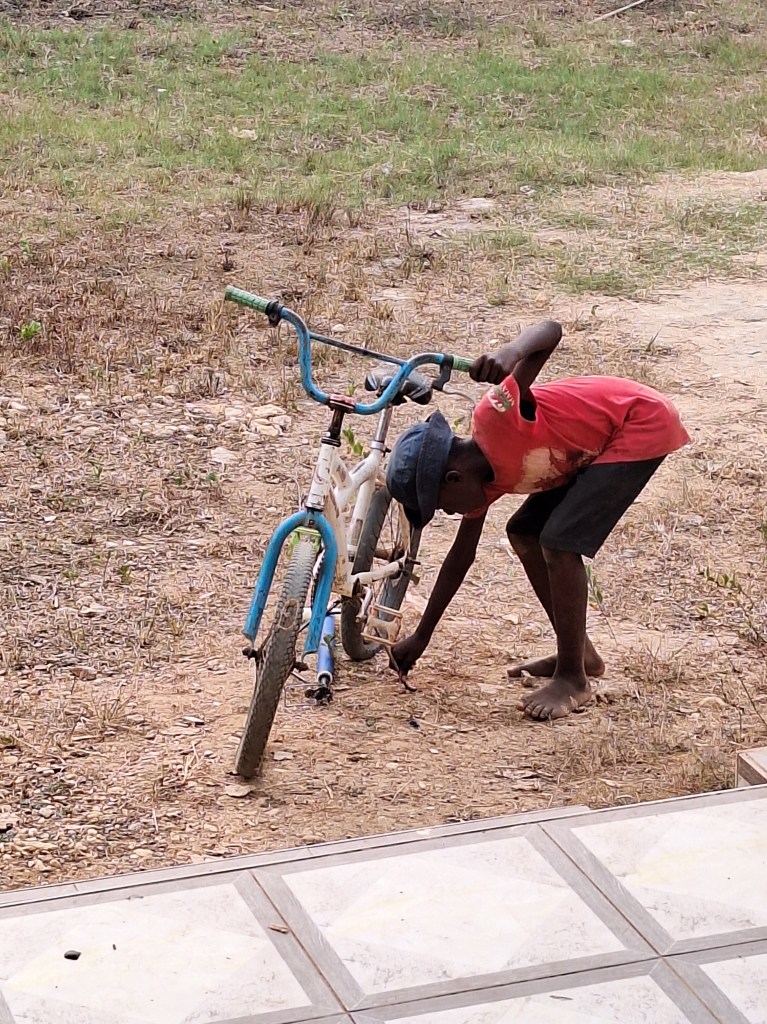
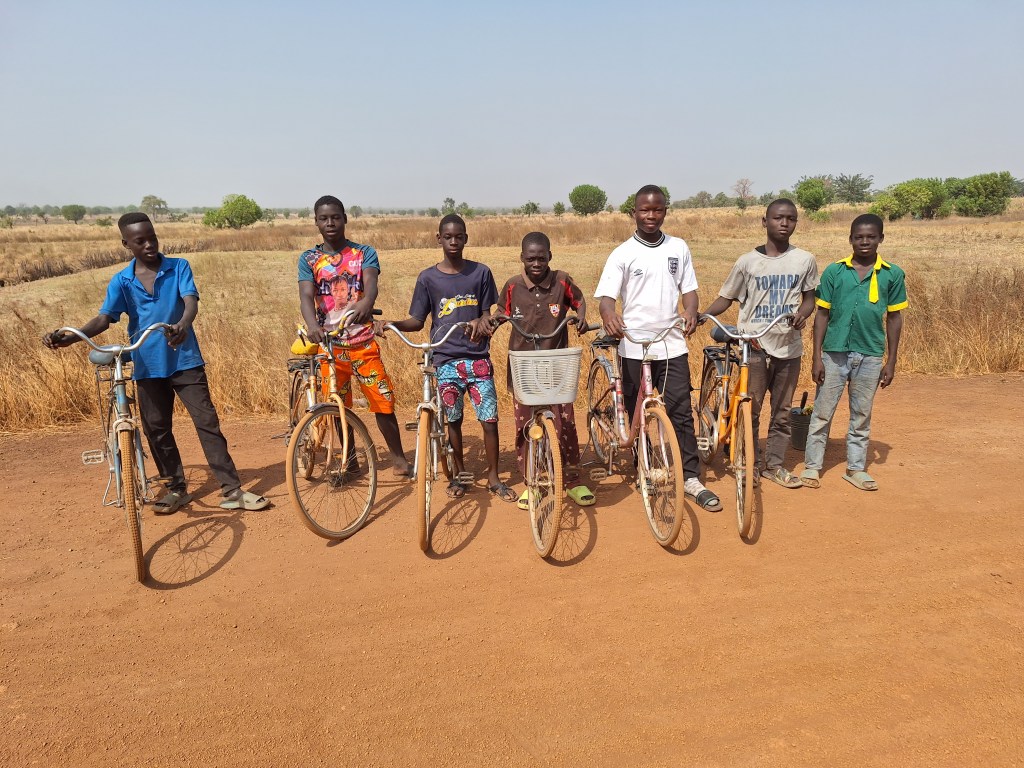
Among the first purchases that I made upon arriving at my village were a bicycle (the subject of a future post) and a bike pump. It didn’t take long before word got out that Teacher Kwadwo has a pump. I’ve met several boys (I don’t recall seeing a girl riding a bike yet) who come wheeling their bikes up the path to my porch, asking if they can use the pump. I’m happy to oblige because the joy of bike riding is the same no matter where you live, and they’re always grateful for the use of the pump. Unfortunately, I’ve gradually come to understand that the need for air is the least of their troubles. I would watch as they pump air into the tire, only to see the crumpled sidewall of their decrepit tire pop out of the rim. They’ll repeatedly refit the tire into the rim and start pumping again. Of course I concluded that they needed a new tire, but money and proper tools are hard to come by and it’s a bad idea for me to open my wallet every time I see a legitimate need, because there are legitimate needs everywhere one looks. At the same time, the boys are proud of their ability to maintain their bikes and insist they they can solve this problem themselves, so I back off and leave them to it. I did try wrapping duct tape (the universal answer) around the tire in an attempt to prevent it from popping out of the rim, but the tape shredded after an hour of riding and wasn’t much help anyway. Eventually the boy(s) manage to get the tire inflated sufficiently such that they can ride away. But within an hour they are back again, asking for the pump. It’s not uncommon to have several requests between 4 PM and 8 PM during a weekday, or all day long on weekends.
I realized how much I underestimated the tire problem when I watched a boy take the tire and tube off the wheel one day. The tire and wheel were about 18 inches in diameter whereas the tube was for a 26 inch wheel! They were folding the tube to fit it into the tire! Throwing caution to the wind, I told the boy to meet with me on Friday afternoon so we could walk his bike to the shop in town and get a new tube of the proper size. That was over a month ago and I haven’t seen him since.
Busted
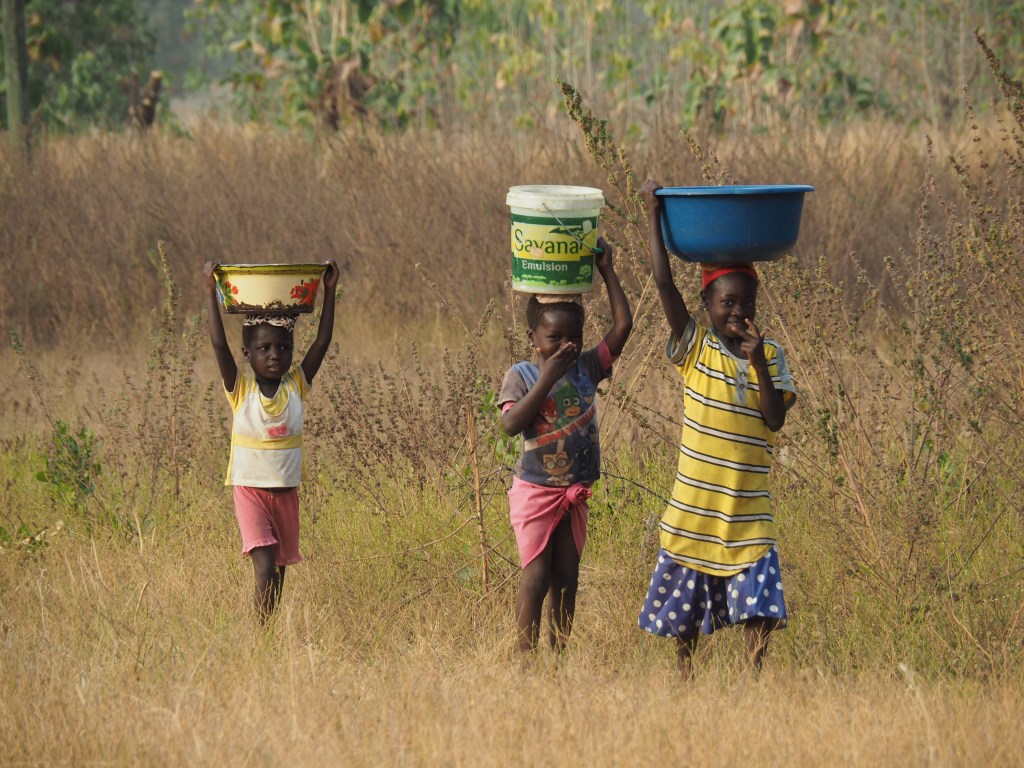
I’ve mentioned previously the embarrassment of riches that I enjoy as far as living conditions. In particular, unlike many volunteers, I don’t have to carry water by the bucketful from a communal water supply every day to meet my needs for drinking, cooking, cleaning, and bathing. For at least a few hours each day I can just open a tap and water will flow directly into my house (and to the flush toilet that fills automatically!), no hauling required, which is good because hauling water can be a time consuming and tiresome exercise. Well, my luck has run out. I’m not sure if the well has run dry because it’s the dry season or if a pipe was damaged during some recent road construction, but I don’t get any water from the tap now. I’m not expecting any sympathy because I’m just experiencing what’s normal life for my PC colleagues, so I’ll just “buck up” and do what needs to be done, as my Dad used to say. For that matter, I feel like I could benefit from the exercise, and the distance isn’t far, so I was keen to take on the challenge.
On a Friday morning when my supply was getting perilously low, I grabbed a big (~5 gallon) bucket and went to wait my turn at the communal water tap (which is independent of the municipal supply). There were probably four or five women and boys there, waiting to fill their buckets. They gestured for me to go ahead of them but I insisted that I could wait my turn. I could understand enough of the subsequent chatter to grasp that my presence was a source of bemusement and disbelief. I didn’t belong there for at least two reasons: first, whether I like it or not, I’m an elder, and elders are worthy of respect. On top of that, I’m a teacher (at least in their eyes), and thus an authority figure and hence worthy of respect. For that matter, I don’t think it’s common for a man to carry water (boys yes, but not adult men). And lastly, I can’t shake the feeling that there’s a strong tendency to give preferential treatment to the white man. I suppose those around me were thinking, “Its just not right! Someone must carry water for him!” Apparently, when I donned my bucket and took my position under the water tap, someone decided that something had to be done.
I did know enough to only fill my bucket a bit more than halfway. A full bucket would amount to 40 pounds of water balanced precariously on the top of my head. More importantly, I have to be able to lift the bucket up off my head and set it down without drenching myself when I get to my house. I was making my way slowly home while carefully balancing the bucket when three students from school came running up and insisted on relieving me of the burden. As near as I can tell, someone called the headmaster, who dispatched the students right away. After delivering that first bucket, they grabbed the other two buckets in my house and made more trips until my 100 liter barrel was nearly full. I expressed my gratitude to them for their work, which probably only made them feel uncomfortable because they were only doing what they’ve been taught is the right thing to do.
I’ve always been loathe to ask someone to do something for me when I could just as well (I think) do it myself. But sometimes it only causes trouble when we upset the established order. I have to learn to ask for (and accept) help.

Food, Part I
This is a very complicated topic that I’ve thought about a lot. It involves all aspects of food: what’s available to purchase, where to find it, how to transport it, how to cook it, how you eat it, and many, many related questions. I’ll have to address each of those aspects separately. But let me start by talking about Ghanaian food.
Life would be so, so, so much easier if I would fall in love with Ghanaian cuisine. There are plenty of roadside and neighborhood stalls selling a wide variety of local foods for very affordable prices. I wouldn’t have to go far to find something to eat, and that would alleviate the burdens of having to shop, cook, and clean up – all of which is very appealing. That said, I’m finding Ghanaian food to be an acquired taste. Among the okay but unexciting dishes are Jollof (a spicy rice dish) and waakye (pronounced watch-ay), a dish of rice and beans that can be topped with spaghetti noodles and spicy sauces. The two most popular dishes are the ones that I struggle with the most: fufu and banku (pronounced bon koo). Fufu is prepared by pounding unripe plantain into a mash in what is basically an oversized mortar and pestle. Next, the cassava is pounded into a mash, and finally the two mashes a pounded together and formed into a ball that is about the size and not quite the texture of a ball of pizza dough (here’s a link to a video if you’re curious: https://www.youtube.com/watch?v=hPD2_whFO8E). Fufu is not cooked, but it is served with a soup or stew. The fufu may be immersed (but not fully submerged) in the bowl of soup or served on the side. You eat fufu by reaching into the bowl, pinching off a piece about the size of a ping-pong ball, dipping it in the soup, and then swallowing it whole, without chewing.
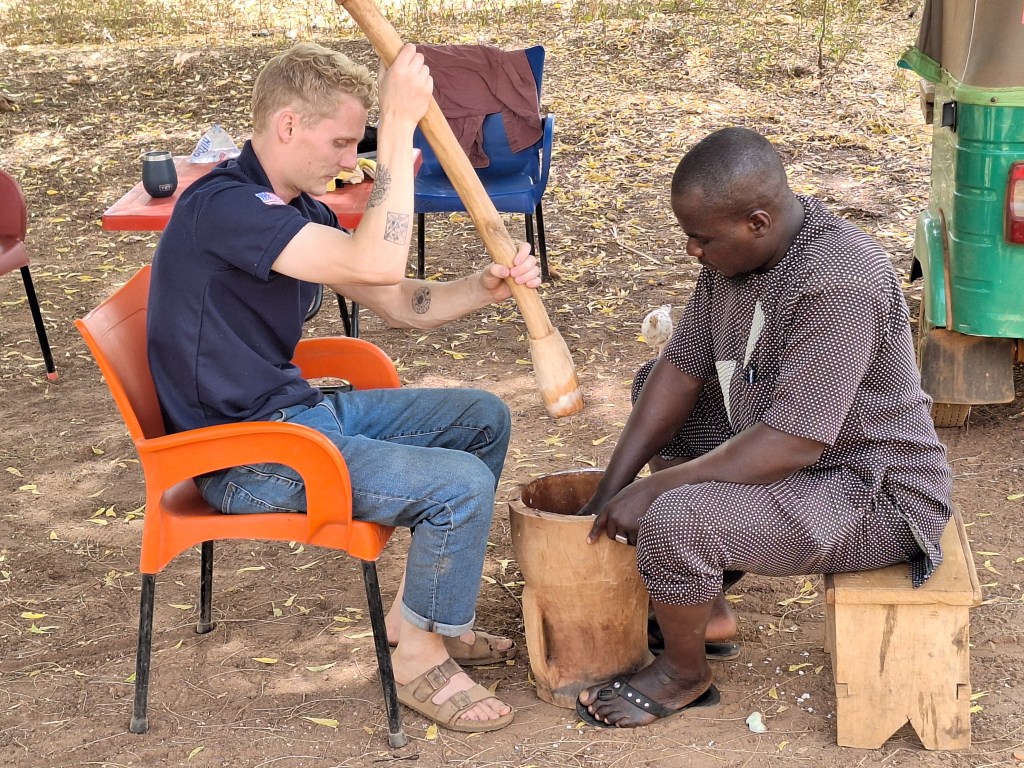
There are a number of difficulties I have with fufu, starting with the idea that you swallow the fufu without chewing it. The only other food I can think of that you just swallow whole are oysters on the half shell, which I will eat but they’re not high on my list of favorite foods. The second issue is the soup. Although it starts with a base of ground garlic, ginger, and onion (a good start), it’s often made with dried fish. Not pieces of fish, but a whole dried fish (I confess I don’t know what kind of fish). The fish absorbs the water from the soup and so is reconstituted a bit. But I’m taken back to the days before Vatican II (i.e., the Second Vatican Council), when we Catholics were not allowed to eat meat on Fridays. In our family, a meal always involved meat, and although my dad was enthusiastic about eating fish, none of the kids were, as I recall. I can still remember the plaintive cry from one sibling or another on Friday evening at dinner, “The fish has bones in it!” Remembering that makes me feel that I’m being childish to complain, but at the very least, having to pick the bones out of my food diminishes the enjoyment of the meal. The work of eating is not compensated by the pleasure received. Another thing that applies to all food in Ghana (and many other countries around the world): you may only eat with your right hand – literally your right hand, because most people don’t use utensils, except spoons to drink the soup.
I’ve heard at least one person say that their father eats fufu almost every day for dinner. I’ve heard another person say that he would eat banku every day if he could. Banku is similar to fufu in that it’s a dough made from fermented cornmeal mixed with cassava. Again, the result is something like a ball about the size of a softball with a doughy consistency. The banku itself is slightly bitter and it’s served with an okra stew. The eating experience is similar to that of fufu, except you can chew banku. Other dishes include ampesi (pronounced om-pay-see), which consists of boiled plantain and/or yams. These are served with a stew (often containing kontomire, which is kind of like kale or collard greens).
In summary, the main part of a typical meal is a starchy filler and it’s accompanied by a soup or stew. Vegetables are not a central part of most dishes. In fact, fruits and vegetables are not considered to be “food”, neither is bread, or oatmeal. If you eat a salad for lunch, then people will say that you haven’t eaten; likewise for fruit. Other than frozen yogurt (a popular sweet treat), dairy is just not an ingredient in Ghanaian food. I’ve been very happy to find plain yogurt and butter in specialty stores, but cheese is found only in bigger cities. Again, I hate to sound like I don’t appreciate the food that Ghanaians love so much and are so proud of, but it’s just not something that I can wholeheartedly dive in to. At the end of a meal I’m full but not satisfied. I just stop eating. No doubt, that’s a significant factor contributing to my loss of about 35 pounds since I arrived last year.
Next up: searching for alternative foods.


 Not A Typical Day
Leave a reply to dmwestin Cancel reply