September 9, 2024
Being away from school gives me time to reflect and consider what I might do differently when the new term begins. After talking with fellow volunteers, I feel empowered to put a stop to the unwelcome interruptions during my lessons. Certainly, students are guilty of many interruptions (e.g., asking to go pee or get some water to drink), but my fellow teachers are just as guilty, if not more so. Teachers will come into the classroom uninvited, sometimes with an apology and a request for “just one minute” to talk to the students or, worse yet, they ignore me and proceed to go from one student to the next collecting money for one fee or another or polling the students on some issue. One time I was interrupted by a teacher who literally couldn’t contain his excitement to show the class the new football uniforms that had just been received. (Interruptions for sports-related activities are all too common, and a significant source of frustration for me.)
Another type of interruption that is especially vexing is what I’ll call the phantom summons. One or more students will suddenly jump up during class and start heading for the door. When I stop them, they’ll say, “Madame Becky [a teacher] is calling me.” Or, “Mr. Nartey [another teacher] is calling for all the boys in Form 1.” Now, my hearing is not what it used to be, perhaps from listening to Jimi Hendrix too loudly in the car, so to me these phantom summonses are like dog whistles – only the students can hear them; I just have to take their word for it.
By the end of the last term, I was getting pretty fed up with these interruptions and I decided to put my foot down. We had already lost a significant amount of class time due to the unwritten but widely accepted rule (among most teachers and students) that sports override all other school activities. I was doing my best one day to complete the syllabus in math class before the final exam when several students (boys and girls) jumped up and started heading for the door. As usual, I asked what’s up and was informed, “Mr. Ghartey is calling us.” Now, I know and like Mr. Ghartey, but I commanded them to sit down. About two minutes later, a student from another class came to inform me that an “emergency assembly” had been called and that all students were required to attend. Emergency assembly?? I’ve never heard of such a thing. Is the school on fire? Did someone discover an infestation of scorpions? What could prompt an “emergency assembly”?
To answer this question, I need to digress a bit. Like every school in Ghana, ours is strapped for resources. When there’s a project to be done that requires materials, the students are almost always given the responsibility of providing at least some of those materials. For example, in the spring, the headmaster (an avid gardener) decided to build a large garden at the school. A garden requires fencing to keep out the goats, sheep, and other varmints who would happily snack on the produce, so every student in the Jr. High School (boys and girls) was told to bring to school (under threat of corporal punishment) at least one wooden fence post approximately 8 ft long and at least 3 inches in diameter, although the specifications are not that specific – in a rural, largely agricultural area, everyone is assumed to know what makes a decent fence post.
Meeting their quota generally means that they sharpen their cutlasses, go into the forest to find a suitable tree, cut it down, and haul it to school. Kids being kids, they tend to work together and help each other. But, virtually everyone walks to school, some a distance of more than a mile. (The students who live in other villages were excused because they wouldn’t be able to carry a pole on the back of the motorcycle that ferries them the two, three, or five miles to the “moto station” at our town, whence they walk the rest of the way to school.) The point is, there’s a fair amount of manual labor required to bring something to school.
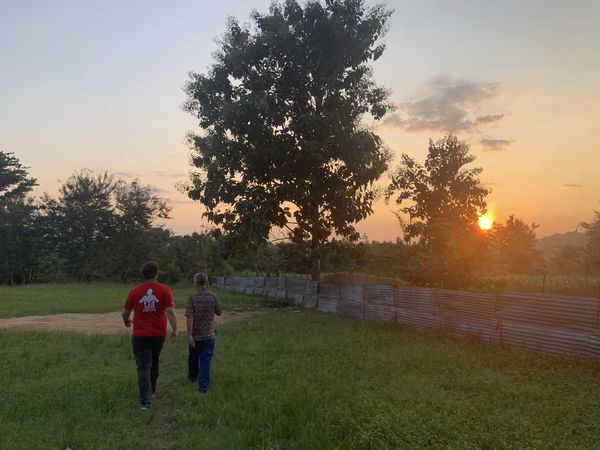
Photo credit: Gina Viner
For another project, students were told they each had to bring one or more bags of rocks to school. Not gravel, but bigger rocks, with an average size between 2 and 3 inches (again, not specific, just, you know, “rocks”). Each bag probably weighed at least 20 pounds, which, like the fence posts, had to be carried to school on foot. In many ways, this assignment provided an opportunity to observe the students’ problem-solving skills. Evidently, one student spied a convenient source of rocks in a pile not far from my home, which is very close to the school. Realizing that it would be much easier to carry an empty bag most of the way to school and then fill it with rocks just before arriving, it made obvious sense that there was a huge benefit to tapping into that nearby source of rocks. (Good thinking!) I suppose they were proud of their resourcefulness and so they spread the word to their classmates. On at least three mornings before school, I observed a group of 2 or 3 students with empty bags of the kind typically used for hauling rocks (sturdy and not too large) make their way around my house to the mystery source and return with full bags. At the time I wondered where they were getting those rocks. Now back to the assembly.
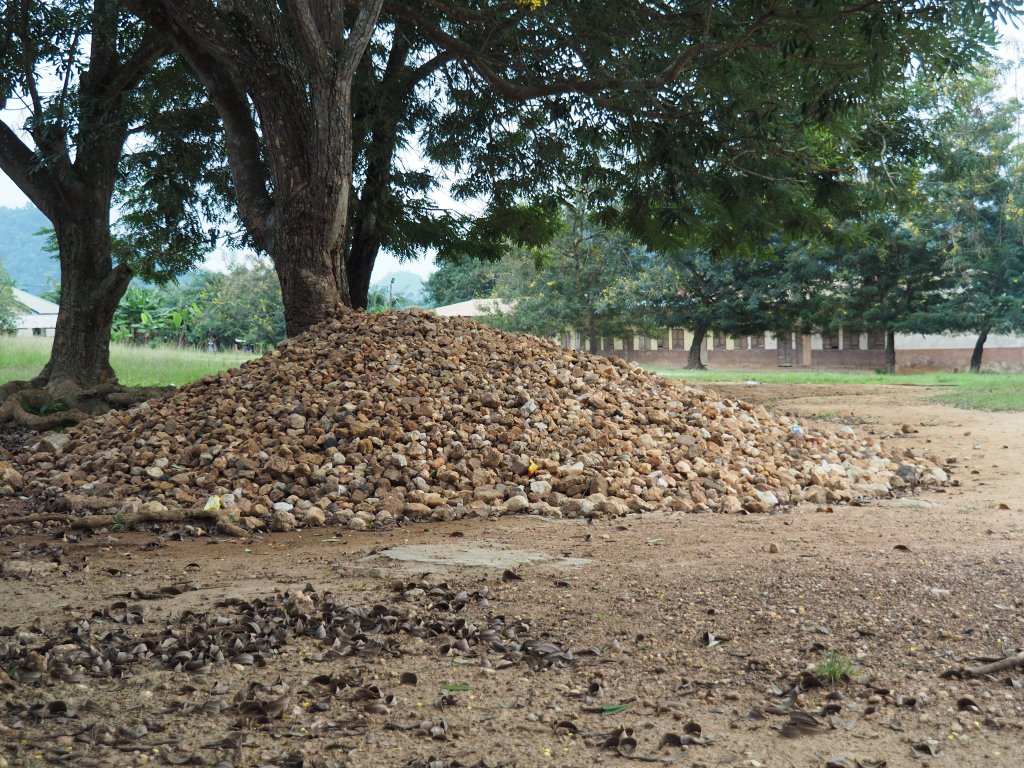
As it turns out, the convenient pile of rocks that the students had found was actually in someone’s yard and had been delivered for a project that the homeowner was planning to have done. When the homeowner (an older woman suffering an affliction of some sort in one or both of her legs) found out what had happened, she was quite upset. My impression is that she felt that the students had taken advantage of her disability to steal rocks from her pile. (I don’t know if students were consciously stealing rocks, or if they simply never stopped to think that those rocks may actually belong to someone.) It probably didn’t take much investigating to identify the culprits, and the owner called the headmaster to vent her anger.
Now, I can understand the homeowner’s anger about students taking rocks without permission, and I concurred with the opinion that the students must return the rocks they took from her pile, but I did not think that the situation rose to a level that constituted an emergency. I was still annoyed by the interruption to my class; certainly, the assembly could have waited until the end of the school day, with the students returning the pilfered rocks immediately thereafter. I vented my frustration to Mr. Ghartey, who then explained the part of the story that I had not heard (because the emergency assembly was conducted in Twi). In her anger, the homeowner threatened to put a curse on the students who stole her rocks. Specifically, she said she would transfer the affliction in her legs to those students. This raised the situation to an emergency, because everyone in Ghana takes curses very seriously. I have since learned that, depending on the seriousness of the situation, if a curse has been cast then the village chief or other local authorities may have to get involved to convince the offending party to make amends and for the aggrieved party to undo the curse. Really serious curses and the efforts to undo them can be fodder for a TV news story.
Following the emergency assembly, the guilty parties (including some students from my class), made quick work of returning the rocks that they had taken. None of them turned up lame, so I assume that the homeowner did not follow through on her threat to curse them. Lastly, I’ve learned that there is such a thing as an “emergency assembly”, so on rare occasions I may have to make allowances for that. But when anyone, whether student or fellow teacher, wants to interrupt my class, I now have a decision criteria I can use: Is it an emergency?
Particle Sighting
Having spent more than 40 years involved in the study of airborne particles, the subject is never far from my mind, even if there’s no one to discuss it with. The billboard below struck home with me for two reasons: first, it has the word Particles in it, and second, I understood precisely what they were advertising.

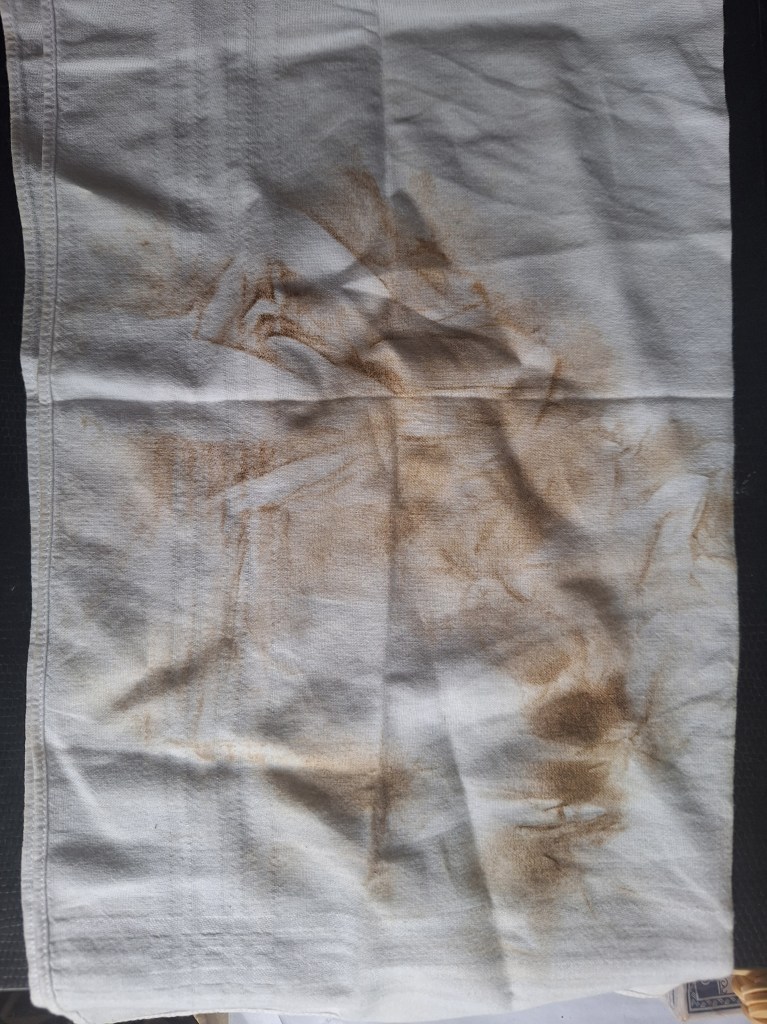
The product is just a standard pocket- or purse-size tissue packet. In the US, a handy tissue package like that has many uses – blow your nose, clean a child’s hands and/or face (or your own) after eating, or as a toilet paper surrogate in an emergency. In Ghana, there’s an application that generally isn’t found in the US – to freshen up after a long ride in a trotro. You see, most trotros lack air conditioning, so the windows are generally left open for ventilation, which is especially welcome when you’re in a vehicle with a dozen or more people. The downside of having the windows open is that whatever is in the air outside of the trotro ends up inside the trotro. That includes diesel and gas engine exhaust (plenty), smoke plumes from about-to-die engines that are burning lots of oil, road dust (especially when the pavement ends and you’re on a dirt road for a while), smoke plumes from roadside fires, and plenty other potential sources. During a two or three hour ride in a warm trotro, a little bit of perspiration and facial oil can collect a lot of particles. The photo below is my handkerchief after I finally got home from a four-hour trip and wiped my face. That’s why the billboard struck a chord with me: Particles!
Goat-of-the-month Club update (a bit overdue)



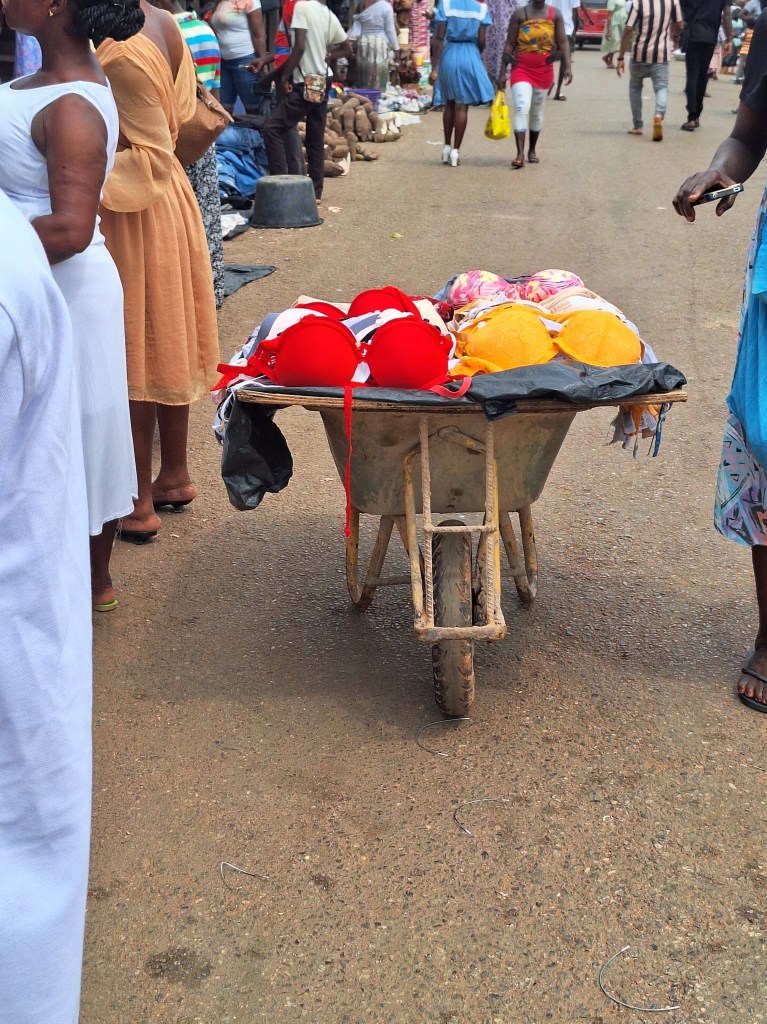
And some scenes from my market town



 Not A Typical Day
Leave a reply to seattlepeggy Cancel reply